Home Contact Us Tip Us: [email protected]






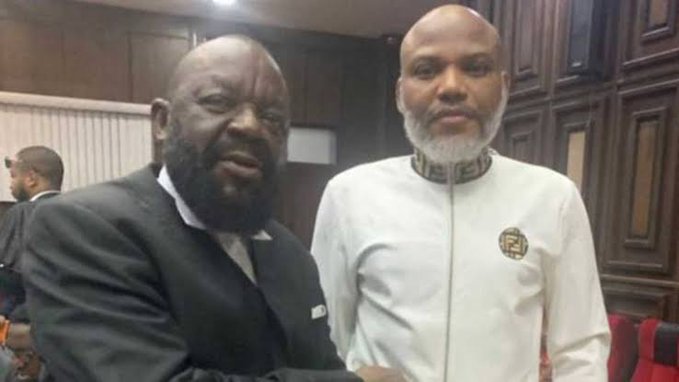
The legal consultant to the convicted IPOB leader Nnamdi Kanu, Aloy Ejimakor, has compared him to the late Chief Obafemi Awolowo, former Premier of the Old Western Region, for choosing to represent himself in court.
In a conversation with The PUNCH on Sunday, Ejimakor suggested that Kanu’s refusal to hire lawyers may be delaying the filing of his appeal against his life imprisonment by the Federal High Court in Abuja.
“MNK has not filed his appeal yet because he has refused to hire lawyers. You know he disengaged us as his lawyers, so we now act in the capacity of a consultant. I am a consultant to him,” Ejimakor said. “I don’t know why he does not want a lawyer, but I believe it is because he is a great man. Many great men are like that. They believe you can’t present their case like they can themselves. Even Awolowo refused to hire lawyers in his time. MNK wants to represent himself, and there are about four or five processes he has to follow to file the appeal before the Appellate Court.”
Ejimakor also backed Kanu’s request to be tranferred to Abuja from the Sokoto Correctional Centre.
He said, “The court already said he can’t be in Kuje prison, so that is fine, but he needs to be closer to Abuja, so if the court will grant his motion to be transferred to Suleja prison or Keffi. To me, there is nothing special about any prison in Nigeria. They are all the same, but MNK needs to be close to Abuja.”
During his trial, Kanu opted to represent himself after disengaging his legal team, headed by a former Attorney General of the Federation and Minister of Justice, Kanu Agabi (SAN).
On November 20, the court found him guilty on all seven terrorism-related charges brought by the Federal Government and sentenced him to life imprisonment.
Following his sentencing, Kanu was moved to the Sokoto correctional Facility due to concerns for his safety at Kuje, where previous prison breaks had been recorded.
He later filed a motion before Justice James Omotosho of the Federal High Court seeking a transfer from Sokoto to a custodial facility closer to Abuja, such as Suleja or Keffi.
In the motion, personally signed by him, Kanu asked that it be deemed moved in absentia and sought an order compelling the Federal Government or Nigerian Correctional Service to effect the transfer.
Citing eight grounds in the motion marked FHC/ABJ/CR/383/2015, Kanu explained that his detention in Sokoto—over 700 kilometres from Abuja—made it impracticable to prepare his notice of appeal and record of appeal.
He stressed that all persons critical to assisting him, including relatives, associates, and legal consultants, are based in Abuja.
“The applicant’s continued detention in Sokoto renders his constitutional right to appeal impracticable, occasioning exceptional hardship and potentially defeating the said right, in violation of Section 36 of the Constitution of the Federal Republic of Nigeria, 1999 (as amended),” the motion stated.
Kanu argued that transferring him to a facility nearer Abuja would enable him to effectively prosecute his constitutionally guaranteed right of appeal.