Home Contact Us Tip Us: [email protected]







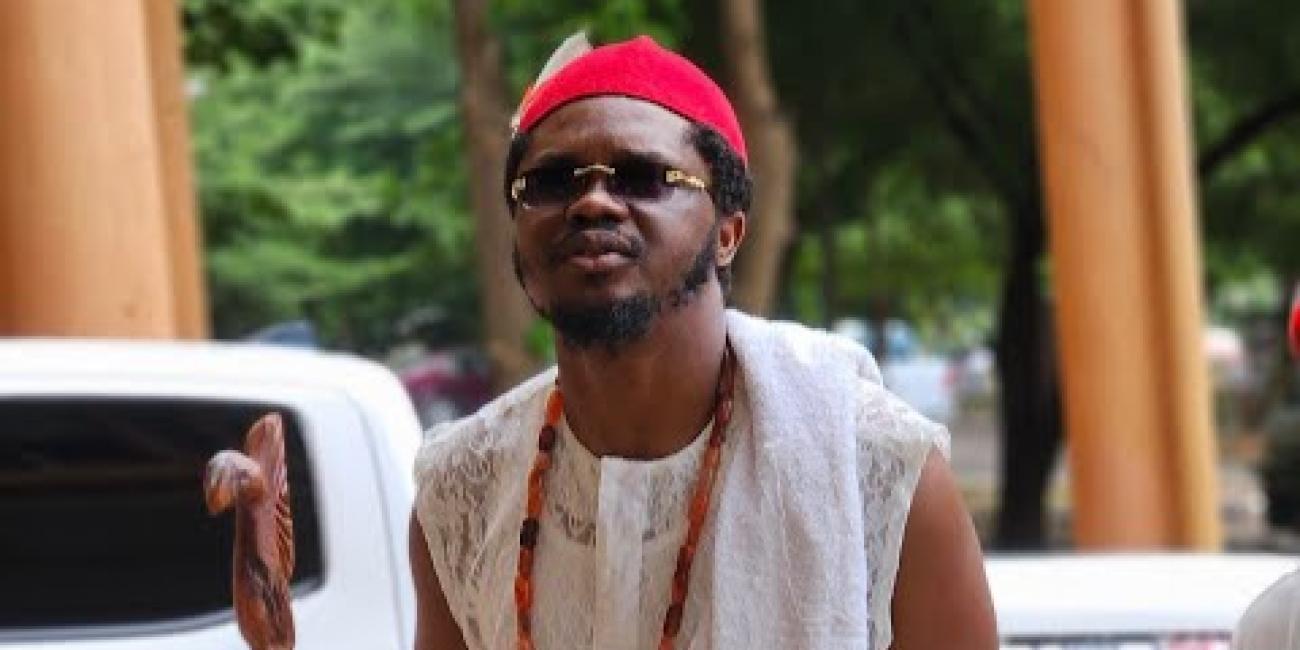
Nigerian filmmaker and practitioner of Igbo traditional religion, Tobe Osigwe, has claimed that Odinala, the Igbo traditional spirituality, is superior to Christianity and other organized religions.
The Theatre Art graduate made the remarks during an exclusive interview with Rudolf Okonkwo on 90MinutesAfrica.
Nze Osigwe, a filmmaker, likened Christianity to a secondary school and Odinala to a tertiary institution.
He argued that any Igbo person who seeks further knowledge after going through Christianity will inevitably land themselves in the practice of Igbo traditional religion.
“Anyone who has gone through Christianity and still wants to further their knowledge will see that the next point of call is traditional religion. Igbo traditional religion is higher than Christianity and other organized religions,” he stated.
He went further to say that many Igbo people remain in Christianity today because of fear.
“They are afraid of going to hell. But some of us already know that hell does not exist. It is only a myth that is used to prop up Christianity so that people will not question the religious foundation,” he said.
Although he spoke passionately about the need for Igbo people to embrace Odinala, the practising dibia was clearly in disagreement with any call for a return to tradition that does not emphasise the importance of education.
He stated that it is only after acquiring that form of education that technological development can be meaningfully discussed in the context of embracing Odinala.
“The ways of our ancestors, or Odinala, are more about values and ethics. But science is a different kettle of fish. Tradition cannot take the place of science. Igbo elites should focus on education that will bring about technological development in the society,” the filmmaker said.
“When we achieve that kind of education, then we can talk about instituting the value systems of our ancestors or Odinala. The Chinese learned technology from the West but maintained their Chinese value systems. I don’t want to go back to tradition to start using an analogue system, but to learn the ethics and value systems of my tradition to be able to use them to safeguard our modern society.”
Speaking on the insecurity in the southeast, the Nnewi-based writer explained that although the situation in the region is gradually improving, he won’t say normalcy has returned until the Monday sit-at-home has come to an end and people begin to go out freely for their everyday activities.
He described the agitators as “terrorists disguising as Biafra agitators.”
He explained how the people living in the region have been disenfranchised educationally and economically by the activities of the Biafra agitators.
“I have three children. My first child is seven years old. She started school in 2021. My last child is four years old, and she started school two years ago. None of the children has gone to school on a Monday since they began schooling,” Nze Tobe said.
“They don’t know what it means to go to school on a Monday. So you can understand the extent of the psychological damage, educational and economic disenfranchisement that is going on in the southeast.”