Home Contact Us Tip Us: [email protected]





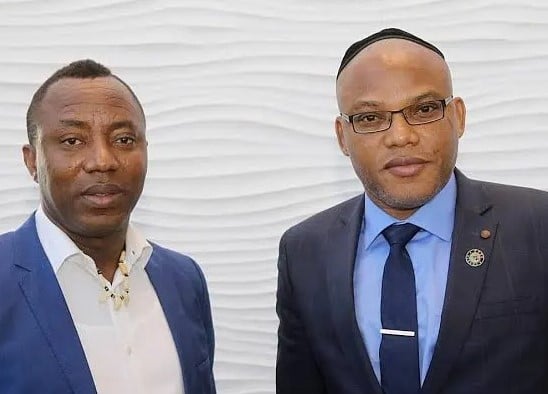
Omoyele Sowore and Nnamdi Kanu
Human rights activist and former presidential candidate Omoyele Sowore has alleged that the life sentence handed to Indigenous People of Biafra (IPOB) leader Nnamdi Kanu was part of a “pre-written script” orchestrated by the Nigerian state, claiming that the trial was politically motivated and lacked transparency.
Speaking during an interview on Perspective, hosted by Ruth Oseme on Arise News, Sowore claimed he had foreknowledge of the judgment days before it was delivered, saying security agents acted violently to suppress public reaction.
He said, “Everything that played out on the day of his conviction was already known to us. On November 5, before the judgment, I posted publicly that the plan was to sentence him to de@th. We organised protests. His lawyers were attacked, we were tear-gassed, arrested and detained for four days. There was a deliberate script.”
He said the government backtracked from an initial plan to impose the de@th penalty because it foresaw “major backlash”, opting instead for life imprisonment. Sowore argued that despite the sentence, the “message Kanu represented” had not been defeated.
He contrasted Kanu’s conviction with what he described as the state’s leniency toward terror leaders responsible for mass killings.
“Actual terrorists have enjoyed preferential treatment. Some move around in convoys with vehicles seized from the Nigerian Army. One even wore a police commissioner’s uniform to town. They hold press conferences with heavy weapons,” he said.
Sowore noted that the primary items tendered as evidence against Kanu included a microphone, radio transmitter and clothes found in a hotel room; items he said could not justify a life sentence, especially for someone kept incommunicado in the custody of the Department of State Services (DSS).
“How is someone in detention, with no access to the outside world, accused of ordering killings? How does he get life imprisonment while a Boko Haram commander who has slaughtered people gets 20 years?” he asked, describing the entire system as “animal farm justice”.
Sowore also accused Southeast political elites of abandoning Kanu for selfish reasons, claiming they feared his popularity and influence over ordinary people.
“I called almost all of them, governors, senators, House members, during the ‘Free Nnamdi Kanu’ protests. Not one of them responded. They were afraid of his political influence,” he said.
According to him, many of the region’s political actors prefer a “political solution” because it allows them to distance themselves publicly while later positioning themselves as brokers who can negotiate conditional release.
“They wanted him jailed first so they could beg for his release and brand him an ex-convict. They wanted that badly,” he added.
Sowore argued that the state’s insistence on keeping Kanu in detention is tied to his refusal to renounce self-determination.
The activist reiterated his long-held view that Nigeria harbours a structural bias against the Igbo, rooted in the aftermath of the Civil War.
“Anyone who says Igbos aren’t treated differently is dishonest,” he said, adding that the federal government’s handling of Kanu’s case is another example of that entrenched inequality.
Addressing speculation about a shadowy cabal controlling Nigeria’s security apparatus, Sowore dismissed the narrative as an excuse used by underperforming leaders.
“The presidency in Nigeria is extremely powerful, arguably more powerful than the U.S. presidency. The number-one cabal is the president himself and the people he appoints,” he said.
“If a president claims someone is tying his hands, he should resign immediately. The office is powerful; the people occupying it are often not competent,” he added, saying many leaders lack the character, capacity, or even physical and mental strength required to govern.