Home Contact Us Tip Us: [email protected]



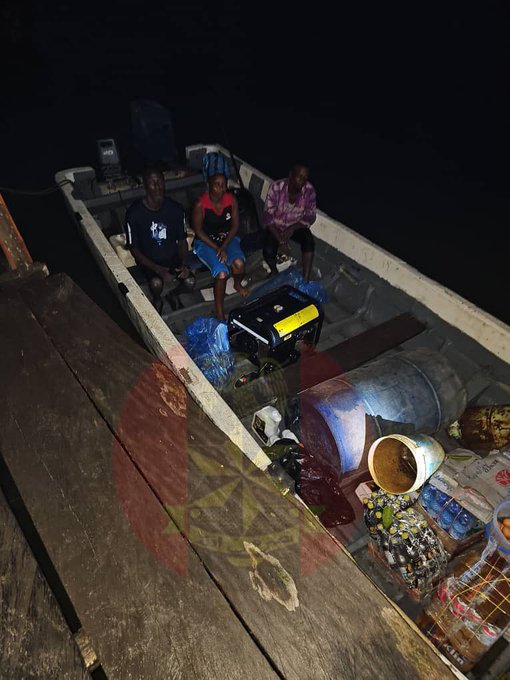
The Nigerian Army has announced that soldiers from its 13 Brigade rescued four kidnapped civilians during a coordinated waterborne operation in Bakassi, Cross River State.
The rescue, conducted on Tuesday, December 2, 2025, occurred after soldiers on routine water patrol intercepted armed militants ferrying the abducted victims in a boat toward Isangele, Achibong, in the Republic of Cameroon.
According to a statement issued by the Assistant Director, Army Public Relations, Headquarters 13 Brigade, Major Yemi Sokoya, the militants opened fire on sighting the patrol team in an attempt to evade arrest.
However, the troops responded with “accurate and superior firepower,” forcing the attackers to abandon the victims and escape into the adjoining creeks.
The Army confirmed that all four abducted civilians were rescued unhurt along with their personal belongings, and no soldier sustained injuries during the operation.
Commander 13 Brigade, Brigadier General P.O. Alimikhena, commended the troops for their vigilance, professionalism, and gallantry.
He said the operation demonstrated the Brigade’s operational readiness and its unwavering commitment to safeguarding residents of Cross River State and surrounding communities.
Alimikhena added that the Brigade would continue to dismantle criminal networks operating across coastal and riverine corridors, while urging residents to cooperate with the military by providing timely and credible information.
The rescue comes amid a worrying escalation of kidnapping incidents across Nigeria, where armed groups, ranging from militant gangs in the South-South to bandits and terror cells in the North, continue to target civilians, commuters, schoolchildren, and workers.
In recent years, coastal and riverine areas, including parts of Cross River, Akwa Ibom, and the Niger Delta, have witnessed increased cases of abductions carried out by criminal groups using waterways as escape routes.
Security analysts note that the proliferation of illicit arms, porous borders, and the use of creeks and mangrove routes for concealment have emboldened these networks.
Across the country, kidnapping-for-ransom has evolved into a lucrative criminal enterprise, with armed groups operating in forests, border communities, and remote settlements.
States such as Kaduna, Zamfara, Niger, and Kogi have experienced recurrent mass abductions, while urban centres, including Abuja, Lagos, and Port Harcourt, have also recorded spikes in targeted kidnappings.
Security agencies have intensified operations in response, including military raids, intelligence-driven arrests, community policing initiatives, and inter-agency collaborations.
However, experts say the persistence of the crime highlights broader challenges tied to weak policing capacity, economic hardship, and the complex terrain exploited by armed groups.
On Wednesday, December 3, 2025, a bill seeking to classify all kidnapping and hostage-taking offences as acts of terrorism passed second reading at the Senate during plenary presided over by Senate President Godswill Akpabio.
The bill proposes the death penalty for all kidnapping-related offences without the option of a fine or alternative sentences.
Lawmakers considered it part of ongoing efforts to amend the country’s terrorism laws.
On the urgency of the matter, Senate President Akpabio said that the bill should move quickly through the legislative process.
The Nigerian Army maintained that ongoing operations, such as waterborne patrols in the South-South and clearance missions in the North, are vital to curbing cross-border movements of criminal elements and restoring safety across affected regions.