Home Contact Us Tip Us: [email protected]



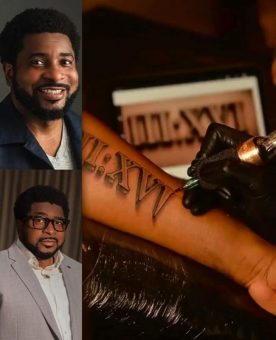
I like Pastor Kingsley Okonkwo. What he has achieved in life is remarkable. I can only dream of the milestones he has attained. I also briefly attended his church in mainland Lagos — a lovely place with beautiful people. He dropped the ball with the tattoo, and he knows it.
Taking an action, publicising it, and then having to repeatedly explain yourself is hard to watch. Pastor Kingsley is a smart man.
If you follow his content on social media, you can tell from his captions and topic choices that he wanted the buzz. You don’t have to be a genius to see that. As he clocked 50, he wanted to make a statement online — an urge many influential people with youthful hearts feel. He made a “little documentary” out of getting a tattoo and announced it publicly. He knew what he was getting into.
He must have done his risk assessment, but he went for it anyway. He gave the tattoo a “divine colouration” by choosing a Bible verse. It was a Roman numeral tattoo on his arm: III: XVI, representing the famous verse John 3:16.
When you publicise an action on social media, it’s hard to control how people will perceive it. Once something feels contentious, it’s often better to keep it private and share it only with close associates who understand you.
Pastor Kingsley likely expected the reactions but felt he could easily weather the storm. After all, it was free publicity — a good deal. But when he felt overwhelmed, he claimed the gospel of Christ would reach millions of Nigerians through his tattoo. That was laughable. He also reiterated that Nigeria had an upcoming election and that youths should channel their energy toward a bigger cause.
From a public relations perspective, those claims only made things worse. He then made a second attempt to change the narrative by setting up a ring light and claiming that tattoos are not unbiblical. He may be right or wrong, but I won’t delve into that. Context matters. Nigerian society is still very conservative and highly judgmental.
You can’t take such actions as a pastor and expect to go unscathed. It’s simply not realistic. In mental health, normal or abnormal behaviour is determined by the environment, and Pastor Kingsley chose the wrong one. This was a Prophet Odumeje-type move. If Odumeje had done this, nobody would bat an eyelid because his brand is already eccentric.
I have nothing against tattoos. In fact, I love them, especially clean ones. The reason I don’t have any is that I believe I wouldn’t stop if I started. Tattoos often turn ugly when people get greedy with them. I also dislike stereotyping. I have always worn an Afro. When I entered the labour market, a friend in the corporate world was furious that I wouldn’t cut it, believing it would jeopardise my chances of getting a good job.
When I moved to the UK, I became more liberal on this subject. My project supervisor there — an exceptionally brilliant Briton of Nigerian descent — looked like someone the Nigerian police might profile at first sight. He had tattoos, braided hair, and wore Timberland boots and wild jeans. But whenever he spoke, the room fell silent because he was the epitome of knowledge. Over time, I met several PhD holders with massive tattoos and coloured hair, and it didn’t stop them from performing their duties excellently.
Nigeria is not like the Western world. Yes, education and international exposure have softened our views on certain issues, but we still question many behaviours we associate with particular groups.
Why is there no longer a distinction between believers and “worldly people”?
Over ten years ago, I performed as a drama artist with a Christian group called The Landlords in Ibadan. The leader wanted to change the idea that Christianity was boring and prove that people could follow Christ and still enjoy life. He organised several worldly-styled events, and people poured in screaming, “Jesus.” It was entertaining. I don’t know if it drew people closer to Christ, as there’s no data to support that.
In those days, dance groups performed in churches alongside comedians. The challenge was that many performers drew inspiration from secular artistes and blended their content to suit church audiences. The one-leg-in, one-leg-out lifestyle was rampant. These figures looked decent and holy on Sundays but were wilder than lions in clubs on Friday nights.
People brought breakdancing into church. Galala and Shoki dance steps became common. It was lively and fun, and the atmosphere was electric. People justified it by saying they were doing the “David dance” in humility before God. As a young adult, I reflected and concluded it wasn’t right. The lines between believers and non-believers were becoming blurred. These people had different playlists on their phones depending on the day of the week: Sundays were for Christian songs until 4 p.m., after which they switched to secular tracks.
They were actors, and the world was their stage. If you think Christianity is boring, then it isn’t for you. If you think being worldly is unsafe, then it isn’t for you either. Those who loved numbers gravitated toward science classes, while those who loved stories chose the arts. Arts students complained that Science classes were boring, yet some students stayed, embraced the boredom, and excelled. The Science class didn’t change into Arts to accommodate those who weren’t meant to be there.
If we’re honest with ourselves, certain behavioural patterns, physical appearances, and communication styles define certain groups. This is universal. When you encounter touts or hoodlums, they’re often loud, aggressive, and brash; their speech may be slurred, and their thinking shallow. Their physical appearance often tells a story about their lives.
Once you see them, you recognise them. That’s likely why the Bible says, “By their fruits, you shall know them.” The same applies to prostitutes. No matter how well they camouflage, a man experienced in such encounters would recognise them — from coloured hair, skimpy clothes, nose rings, leg chains, and swagger. Sometimes personal judgments fail, and I must add that caveat.
A friend of mine once approached a woman on the busy streets of Yaba, Lagos State, assuming she was a sex worker. She went straight to business, then became furious and embarrassed. Eventually, she complied. During their encounter, she reportedly asked, “You don’t know me and have never met me, so how did you conclude I was into this?” He smiled and replied, “The way you carried yourself.” She became even more curious and confused.
The moral is that every profession has an ID card — visible or invisible. Even when you meet a banker at a roadside canteen, it’s not hard to tell who they are. The same applies to mechanics, vulcanisers, and panel beaters in Nigeria. The Yoruba say that when you meet a prince, you will find traces of royalty in him.
Today, we have Christians who miss their days on the streets. Their position has changed, but their hearts long for the past. They want throwback experiences on Thursdays. Some gospel artistes make music that sounds secular to trend and appeal to wider audiences — and the benefits can be good.
Others watch music videos and want to dress like hip-hop artists. As someone with a background in psychology, I tend to read meaning into traits and behavioural patterns people often ignore, because behaviour is a form of direct and indirect communication. Human behaviour is the tip of the iceberg; when you look deeper, you discover the powerful forces driving it.
The Bible teaches believers not to be unequally yoked with unbelievers. Today, that line is blurred and almost non-existent. Believers drink to a stupor and jokingly claim the water Jesus turned into wine was alcoholic. Chronic users ask to be shown where the Bible condemns smoking or vaping. Controversially, homosexuality has also gained acceptance in parts of Christendom. People are worried, but change feels unstoppable. That’s evolution — and that’s life.
Pastor K, as he is fondly called, scored an own goal. I’m sure his close associates told him so. He has threatened to get more tattoos, which is quite interesting. I truly wish he would make the news for healing the sick or writing one of the best marriage books in the world — not this, please.
***
Osahon Osayimwen writes from England.
***
NOTE:
The views and opinions expressed in this article are those of the author and do not necessarily reflect the views, opinions, or editorial stance of this platform. We do not endorse or take responsibility for all statements made within contributed content.