Home Contact Us Tip Us: [email protected]






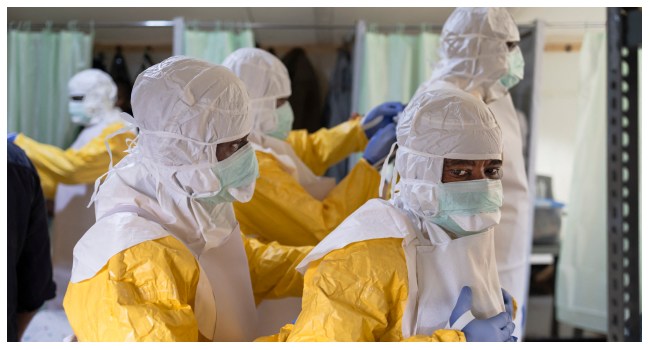
(Health workers. Photo by Channels TV)
Health workers battling the Ebola outbreak in the Democratic Republic of Congo are threatening to down tools over unpaid salaries, even as the World Health Organization cautioned on Tuesday that the true scale of the epidemic could be as much as four times higher than official figures suggest.
The highly contagious virus has claimed more than 700 lives out of nearly 2,000 confirmed cases in the DRC since the outbreak was announced on May 15, according to the most recent official figures released on Tuesday.
However, the WHO noted that the actual extent of the outbreak could be between two and four times greater than what has been officially recorded.
Adding to the challenges facing the response effort, health workers stationed at the heart of the epidemic told AFP they have gone unpaid since the virus was first detected.
At the Ebola treatment centre in Rwampara, located in one of the hardest-hit areas within the epicentre in the northeastern province of Ituri, health workers set tyres ablaze in protest on Monday and briefly barred access to the facility.
"We've been treating Ebola patients without pay since May 15. We continue to do so because that is our oath, but we are working in very difficult conditions," said Dr Pascal Bahoya.
Medical staff at the centre indicated that unless the authorities responded to their "48-hour ultimatum for salaries and bonuses," they would proceed with a "full-scale strike," withdrawing even minimum service.
Health Minister Samuel Roger Kamba, during a visit to Ituri on Thursday, admitted there had been "delays in payment" and pledged that the underlying "organisational issue" would be addressed.
Frontline health workers are finding it difficult to contain the spread of the virus within the vast Central African nation, one of the poorest countries in the world.
Data from the national public health institute (INSP) shows that at least 112 healthcare workers have contracted the virus, with 35 losing their lives.
Ebola is a viral haemorrhagic fever transmitted through direct contact with bodily fluids, capable of causing severe bleeding and organ failure.
No vaccine or targeted treatment currently exists for the Bundibugyo strain responsible for this outbreak, which has now spread across five provinces in eastern DRC, extending from its origin in Ituri to North Kivu, South Kivu, Tshopo, and Haut-Uele.
Eastern DRC, a region rich in minerals, has endured three decades of ongoing conflict, with large numbers of people displaced and living in camps that the United Nations describes as lacking clean water and adequate sanitation.
Ituri shares a border with South Sudan and Uganda, the latter of which has recorded 20 cases, including two fatalities.
As of July 12, a total of 727 patients were receiving treatment at Ebola centres across the affected regions, while a clinical trial testing two potential treatments is currently ongoing.
The actual magnitude of the outbreak, thought to have started months before it was officially identified, remains hard to determine.
Aid workers on the ground have expressed belief that the official numbers understate the true situation.
WHO emergencies director Chikwe Ihekweazu told journalists in Geneva that the agency's modelling suggests "the scale of the outbreak is at least two to four times the number of cases that we have found."
So far, the global community has mobilised $1.5 billion to back the DRC's response efforts, in a country whose healthcare system remains persistently underfunded.