Home Contact Us Tip Us: [email protected]







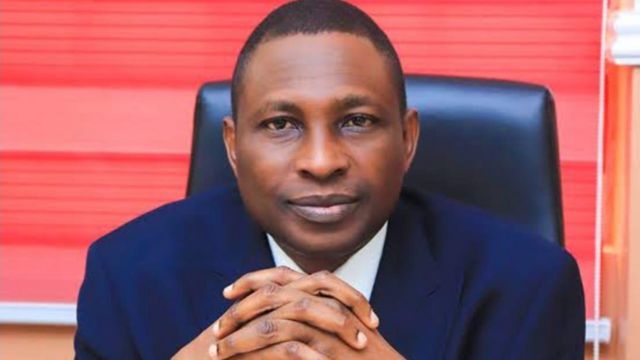
Mr. Ola Olukoyede, the Chairman of the Economic and Financial Crimes Commission (EFCC), has expressed concern over the growing presence of foreign fraud syndicates in Nigeria, revealing that they are establishing cybercrime cells and recruiting young Nigerians into organised financial crimes, including cryptocurrency fraud.
Olukoyede made this revelation on Wednesday, February 26, 2025, while receiving participants of the Executive Intelligence Management Course (EIMC) 18 from the National Institute for Security Studies (NISS), led by Director of Studies, Hyginus Ngele, at the EFCC headquarters.
He expressed concerns over how insurgents and bandits sustain their operations, highlighting the illicit flow of small arms and light weapons across Nigeria’s borders and the role of non-state actors in illegal mineral exploitation.
“Another dimension that is not given enough attention is the discovery, recently, that organized foreign fraud syndicates are establishing cells in Nigerian cities and recruiting young Nigerians into serious organized cybercrimes, including cryptocurrency fraud,” Olukoyede stated.
He further warned that these criminal networks may be using cryptocurrency to facilitate the illegal importation of arms into Nigeria, a development that demands urgent security intervention.
“In the special operations we carried out in Lagos recently, we arrested 194 foreigners in the heart of Victoria Island. One hundred and ninety-four of them—Chinese, Filipinos, Eastern Europeans, Tunisians—were found operating in one building at the same time. Some of them didn’t even have valid visas, and most of their financial transactions were conducted using cryptocurrency,” he disclosed.
Olukoyede also revealed that some of the arrested foreigners were ex-convicts in their home countries who had fled to Africa, using Nigeria as a safe haven.
According to EFCC investigations, these fraud syndicates are also expanding their operations to other African nations.
The EFCC chairman has called for intensified efforts at both national and continental levels to tackle the growing threat of internet fraud.
He emphasised that the involvement of foreign-organised crime groups in money laundering and national security concerns requires heightened vigilance.
“All security, intelligence, and law enforcement agencies in Nigeria, and indeed across Africa, must collaborate to address this challenge,” he stated.
Olukoyede lamented that Nigeria has faced persistent security challenges for nearly two decades, including insurgency, banditry, kidnapping for ransom, and farmer-herder conflicts.
He partially attributed these issues to the activities of non-state actors, stressing that their role in fueling insecurity and corruption has not been thoroughly examined.
“At the EFCC, we have always been wary of the influence of non-state actors in areas with security concerns,” he noted. “In the Northeast, for example, the activities of local and international NGOs have come under scrutiny.”
"This prompted the decision to require their registration with the Special Control Unit against Money Laundering (SCUML), a department within the EFCC, and to enforce a directive mandating notification to the Commission regarding cash movements within the region," he added.