Archaelogists have discovered what they believe may be the largest single mass child sacrifice event in human history.
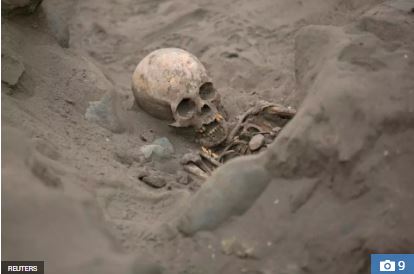
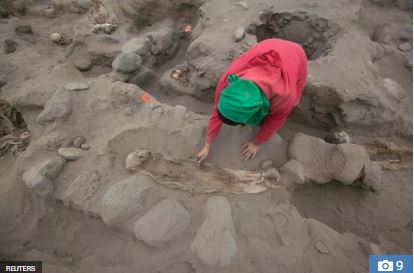
More than 140 children - aged between five and 14 - were slaughtered at the same time in Peru's northern coastal region, about 550 years ago.
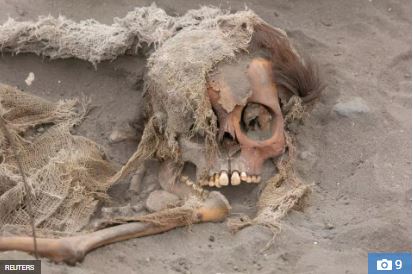
The children’s ruptured remains contained cuts to their breastbones, which are believed to have been made by a ceremonial knife.
Dislocated rib cages suggest whoever carried out the bloody sacrifices may have been trying to tear out the HEARTS.
Several ancient cultures including the Mayas, Aztecs and Incas practised human sacrifices
Researchers also found small footprints that have survived the centuries which indicate the children were marched to their deaths from Chan Chan, an ancient city one mile away.
The discovery was made near modern-day Trujillo, Peru, which lies near the centre of the ancient Chimú civilisation.
More than 200 young llamas were also sacrificed alongside the children - all of which were killed at the same time at the burial site known as Las Llamas.
It is thought the children were sacrificed to the gods to prevent further floods caused by the El Nino storms which ravaged the Peruvian coastline.
The children were apparently marched to their deaths from their homes
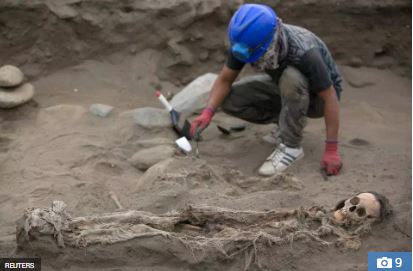
“They were possibly offering the gods the most important thing they had as a society,” said Professor Gabriel Prieto, of the National University of Trujillo, who led the excavation along.
“Llamas were also very important because these people had no other beasts of burden; they were a fundamental part of the economy.”
Prieto revealed all of the children were buried facing the sea, while the llamas faced the Andes mountains to the east.
It is thought the children were sacrificed to the gods to prevent floods
"We have an unprecedented case in Peruvian archaeology of having this massive, I would say biblical, number of people, particularly children, who have been sacrificed in this area," said Prieto.
Prieto believes the children were killed to plead with the gods to calm heavy rains and river overflows caused by El Niño.
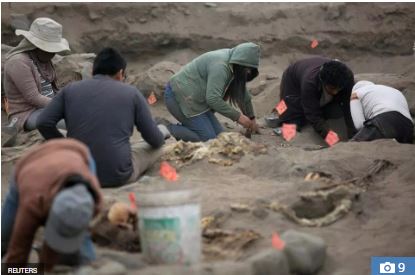
Excavation work at the burial site started in 2011, but the findings have only just been published by National Geographic, which helped finance the dig.
Jeffrey Quilter, the director of the Peabody Museum of Archaeology and Ethnology at Harvard University, described it as a “remarkable discovery”.
More than 140 children - aged between five and 14 - were slaughtered
He said the site provides “concrete evidence” that large-scale sacrifices of children happened in ancient Peru.
“Reports of very large sacrifices are known from other parts of the world, but it is difficult to know if the numbers are exaggerated or not,” Quilter said.
Quilter is heading a team of scientists who will analyse DNA samples from the remains to see if they were related and figure out which areas of the Chimú empire they came from.
Several ancient cultures including the Mayas, Aztecs and Incas practised human sacrifices, but the mass sacrifice of children has rarely been documented.
***
 Home
Home