The latest clashes, according to MSF, have yet again forced tens of thousands from their homes, fields and livelihoods, and left them struggling to survive.
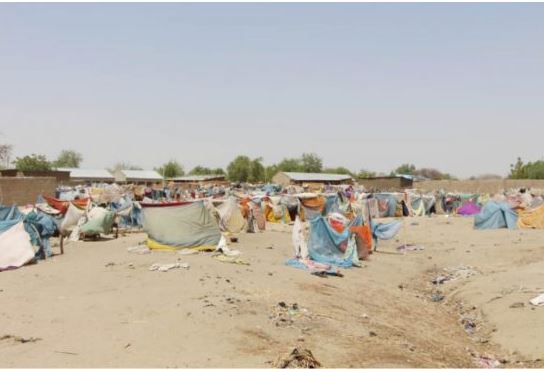
Some of the IDPs sleeping in the open
Hajja Bukar, 35, recently arrived in Monguno, having been displaced a number of times already in recent years due to the Boko Haram conflict.
She and her four children, who hail from Northern Borno, have settled in one of the town’s camps for displaced people, in a rudimentary shelter made of sticks and textile materials.
“We are surviving by doing menial jobs like washing dishes and getting paid for it, while our men sometimes go into the bush to fetch firewood to sell,” says Hajja.
Hajja is an unconscious spokesperson of the tens of thousands of the IDPs languishing in excruciating hardships in camps in Monguno.
Over 30,000 people, who fled to the town, following renewed clashes that erupted in Northern Borno state in late December are in acute need of shelter, water, sanitation, food, protection, medical care and mental health support, warns international humanitarian organisation Médecins Sans Frontières (Doctors Without Borders (MSF).
The international NGO complained recently in a statement mailed to KanemTrust that the IDPs immediate humanitarian needs are not being adequately addressed.
MSF said there is an urgent need for better coordination between the Nigerian government, United Nations and non-governmental organisations in scaling up the aid response in Monguno so as to avoid a catastrophic situation with the onset of the rainy season expected in May.
“For the last 10 years, people in Borno state have been caught up in a cycle of violence, displacement, and insecurity,” MSF recalled in the statement mailed by its Maiduguri Commucation Officer, Abdulkarim Yakubu, complaining, “people’s health are at risk due to the dire living conditions”.
The latest clashes, according to MSF, have yet again forced tens of thousands from their homes, fields and livelihoods, and left them struggling to survive.
“People who recently arrived in Monguno fled their homelands leaving everything behind,” says MSF humanitarian affairs officer Musa Baba.
“They come from areas where they could farm. Now, they are sleeping on the streets or wherever they can find space, hungry, thirsty and exposed to very high temperatures during the day and low temperatures at night.”
MSF complained further: “A major problem in Monguno is the lack of land to build shelters for new arrivals. Thousands of recently displaced people have no space to settle and are living and sleeping in the middle of the town’s streets for weeks, even months.
“MSF, along with some other humanitarian organisations, have built shelters in different camps and have capacity to accommodate more displaced people. MSF teams have set up 100 tents and are ready to put up 700 additional shelters.
“The current situation, with very vulnerable people – women, children and the elderly – living out of doors, rather than in a camp or with the host community, increases the risk of abuses and the need for protection,” says Musa.
Poor living conditions with little sanitation and a lack of safe drinking water, according to MSF, are putting displaced people in Monguno at risk of pneumonia, diarrhoea and malaria, among other preventable diseases.
It added that with few latrines, most IDPs are used to open defecation in the areas, which are likely to flood in the rainy season, worsening the health conditions.
MSF is running a 10-bed emergency room for adults in a ministry of health facility in Monguno as well as providing people with mental health support.
Following an accidental fire in Stadium camp for displaced people last February, where 850 displaced families are sheltering, MSF distributed 500 kits of essential relief items including mats, tarpaulins, blankets, jerry cans, cooking equipment and hygiene items.
In response, the Borno State Emergency Management Agency (SEMA) and NEMA officials said in spite of the continuing influx of people fleeing attacks from Northern Borno communities, amidst dwindling humanitarian aid from international donors, their agencies have been doing ‘so much’ to cushion the effects of the hardships encountered by the IDPs.
 Home
Home