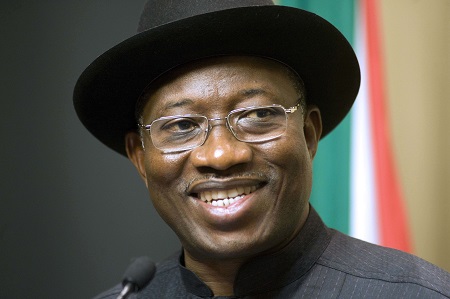
Former President Goodluck Jonathan has opened up on the tensed moments he faced on March 28, 2015 ahead of his decision to concede victory to President Muhammadu Buhari after that year's presidential election.
Jonathan told his story, last week, during a dinner in his honour by Cercle Diplomatique, Geneva, Switzerland. The former President also spoke about his foray into politics, the allure of power and future plans.
He said:
"I believe that not many of you here know that the story of my foray into politics has a peculiar ring to it. I entered politics in 1998 and, barely one year after, I got elected as the Deputy Governor of Bayelsa, my state. I later became Governor, Vice President and eventually got elected as the President of my country. I remain the only leader in my country to have travelled that route.
"As the President, I served out my first term but, as Mr. Blum had pointed out earlier, I lost the bid to be re-elected. I am encouraged by the fact that many of you here appreciated my decision not to reject or contest my loss at the polls, not even in the courts as many people had expected.
The allure of power
“Again, I have to agree with Blum that it was not an easy decision to take. This is because the allure of power and the worries about what would become of you after leaving office constitute an irresistible force. It has an attraction so controlling and powerful that it takes a man who has the fear of God and who loves his people and nation to relinquish power so easily in Africa.
Alone in the valley
“I was actually in that valley on March 28, 2015. I never knew that the human brain had the capacity for such enhanced rapid thinking. One hundred and one things were coursing through my mind every second. My country was at the verge of collapse. The tension in the land was abysmally high and palpable, in the months and days leading to the election. The country became more polarized more than ever before, such that the gap between the North and the South and between Christians and Muslims became quite pronounced. In fact, it became so disturbing that some interest groups in the United States began to predict that Nigeria would disintegrate in 2015. And, indeed, many Nigerians did buy into this doomsday prophesy as they began to brace themselves for the worst. As the President, I reminded myself that the Government I led had invested so much effort into building our country. I worked hard with my top officials to encourage Nigerians and non-Nigerians to invest in our country to be able to provide jobs and improve the lives of our people. We worked hard to grow our economy and to improve and bring Nigeria up as the biggest economy in Africa, with a GDP of about half a trillion dollars.
Posers I had to contend with
“Should I then, for the love of power, watch Nigeria slide into a theatre of war, with my fellow country men and women dying, and many more pouring into other nations in Africa and beyond, as refugees?
"Should I hang on to power and tussle with my challengers, while the investments of hard working citizens of the world go down the drain? I then said to myself, NO!
Resisting the lure of power
“I promised my God that I will not let that fate befall Nigeria under my watch, hence the historic telephone call I put through to congratulate my challenger even when the results were still being tallied. I believe that for a country to be great, both the leaders and the led must be prepared to make sacrifices. This is why, everywhere I go, I always advise that the new generation of African leaders must think differently. We can no longer afford to wilfully sacrifice the blood of our citizens on the altar of dangerous partisan politics. It is not worth it. This reminds me of one of my campaign statements to the effect that my ambition was not worth the shedding of the blood of any Nigerian. Some people took it then as mere political slogan but I knew that I meant it when I said it.
"We must all fight for the enthronement of political stability in Africa, for in it lies the panacea for sustainable growth and development. For Africa to record the kind of advancement that will be competitive and beneficial to our citizens, we must have stable states supported by strong institutions. That appears to be the irreducible minimum that is common to all developed societies. Africa’s political odyssey can distinctly be categorised into three eras, and probably another that would later signpost its classification as a developed continent”.
 Home
Home