Home Contact Us Tip Us: [email protected]







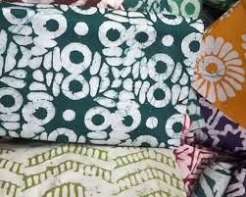
(Adire fabrics. Photo by Punch News)
Dr. Tunde Bajela, a financial expert and Managing Consultant/CEO of Superbrains Consulting Limited, has called on the Federal Government to invest strategically in Nigeria's indigenous Adire business.
According to Bajela, if the industry is properly promoted, it may grow into a $1 billion global enterprise.
He made the request on Thursday while giving the keynote speech at the Adire Renaissance stakeholders' engagement in Abeokuta, Ogun State, themed "How Adire Becomes $1 billion Trade Asset from Africa to America and Beyond."
In collaboration with Wessy College of Arts and Technology, Abeokuta, the Innovation Center for Leadership and Entrepreneurship Development organized the program.
According to him, Nigeria's expanding textile industry offers a special chance to relaunch Adire as an internationally competitive commodity that may increase non-oil exports, create jobs, and generate substantial cash.
He claims that even though Nigeria still imports more than 95% of its textile resources, the country's textile market is expected to increase from over $9 billion in 2025 to over $16.62 billion by 2034.
According to Bajela, creating the Adire value chain will give regional manufacturers access to the growing global fashion market.
The global market for textiles and clothes is estimated to be worth $1.24 trillion. Even if Nigeria were to develop the Adire industry into a $1 billion enterprise, we would still hold less than 0.01 percent of the worldwide market.
"There is a huge opportunity. The commercial potential of our indigenous textile history has only just begun to be realized," he stated.
As part of larger initiatives to diversify the economy and lessen reliance on imported materials, he urged the federal government, financial institutions, and private investors to direct resources toward domestic textile manufacture.
The consultant also expressed concern about the growing number of foreign-made textiles that mimic traditional Adire designs, characterizing this development as a serious danger to local producers.
However, he insisted that because of its uniqueness and cultural significance, handcrafted Adire continued to have a competitive advantage.
The distinctiveness of handcrafted Adire cannot be duplicated by foreign manufacturers, even if they continue to produce copycat fabrics in large quantities.
"Our products have an authenticity that commands premium value in the international market, thanks to the creativity of local artisans and research institutions," he stated.
According to Bajela, increasing Adire production will boost chemical processing, cotton cultivation, dye manufacturing, and other auxiliary businesses while generating jobs, particularly for women and young people.
He promoted the creation of a special Adire Fund to offer reasonably priced financing for manufacturers, craftsmen, and other value chain participants in order to unleash the industry's potential.
Speaking as well, Dr. Tomi Coker, Ogun State Commissioner for Health, stated that the state government has persisted in enacting laws meant to protect Adire as a cultural legacy while promoting it as a significant engine of economic growth.
According to Coker, Governor Dapo Abiodun's goal of advancing indigenous businesses and increasing financial prospects for regional craftspeople was in line with the Adire Renaissance program.
She claimed that the governor had continuously used his own attire to promote the indigenous fabric.
"If you look at the Governor, he wears Adire with pride every day. He now serves as an ambassador for the cloth, supporting our own art and boosting the local economy, she said.
Coker revealed that the state administration had made it official for public officials to wear Adire every Friday in order to promote the use of locally made textiles.
In order to introduce children to indigenous materials at a young age, she continued, talks about implementing school uniforms inspired by Adire were ongoing.
Resolving issues related to foreign imitation The state government is backing legislative initiatives to deter the importation of machine-made copies, especially those created in China, according to commissioner Adire.
"Because Chinese-made Adire items hurt our local market, the government is developing policies to forbid their importation.
In order to safeguard local producers and maintain the authenticity of Adire, a lot is going on behind the scenes, she stated.
Earlier, the founder of ICLED, Prof Olajumoke Familoni, said the Adire Renaissance initiative was designed to preserve the originality of Adire while equipping young people, especially girls, with skills in science, technology, entrepreneurship and textile production.
She explained that the organisation had continued to collaborate with local and international institutions on programmes focused on education, entrepreneurship and community development.
“Our focus this year is on STEM because we want to inspire creativity in the girl child and encourage her to become an active participant in the Adire value chain,” she said.
Familoni revealed that about three years ago, the Alake and Paramount Ruler of Egbaland, Oba Adedotun Gbadebo, challenged ICLED to address the growing problem of Adire adulteration.
She said plans were underway to establish an Adire Hub that would preserve the history and authenticity of the fabric while promoting innovation within the industry.
According to her, the proposed facility will include an Adire museum, historical archives, exhibition galleries, original Adire pattern collections and displays of locally produced items such as bags, shoes and home décor products.
“Our girls are creative, brilliant and innovative. They can create beautiful patterns and designs, and they can also experiment to produce the Aro dye used in Adire fabric production,” she said.
Calling for greater investment in local manufacturing, Familoni urged governments at all levels to support indigenous industries, stressing that Nigeria’s economic future depended on building strong domestic production capacity.
“As a nation, we cannot continue to import everything we need. We must manufacture and produce our own goods, not only food but also textiles and other valuable products,” she said.
Adire, a traditional hand-dyed fabric with deep roots in Ogun State, particularly among the Egba people of Abeokuta, has gained increasing recognition both locally and internationally as a symbol of Nigeria’s cultural heritage.
In recent years, governments, industry stakeholders and cultural advocates have intensified efforts to promote the indigenous fabric as a viable non-oil export and a driver of job creation.